



Contact Us
Download N3uron

N3uron Software Modules

One Industrial Historian from a Single Site to Enterprise Scale

Capture, store, and serve contextualized industrial time series data from the edge to the enterprise. Start fast with EmbeddedDB powered by MongoDB, then scale with external MongoDB or TimescaleDB instances as your historian architecture grows.

Part of N3uron, the Industrial Edge Software Platform for Distributed DataOps.

Same Historian. Flexible storage. One architecture that grows with your operations.

How N3uron Historian Scales with Your Architecture

Start with local history at the edge, then expand to centralized historical data access as your operations grow.

Deploy N3uron at the edge to collect, standardize, normalize, and contextualize industrial data close to operations. Start storing history locally with EmbeddedDB powered by MongoDB, or connect Historian to external MongoDB or TimescaleDB instances as your storage, performance, and consolidation needs grow.

Across sites, the same Historian architecture can support local storage, centralized history, and enterprise data access for dashboards, BI tools, maintenance systems, remote operations centers, and business applications.

Start at one site. Keep your options open. Scale across operations.

From Local Historian to Enterprise Data Access

Start local. Keep your options open. Scale across operations.

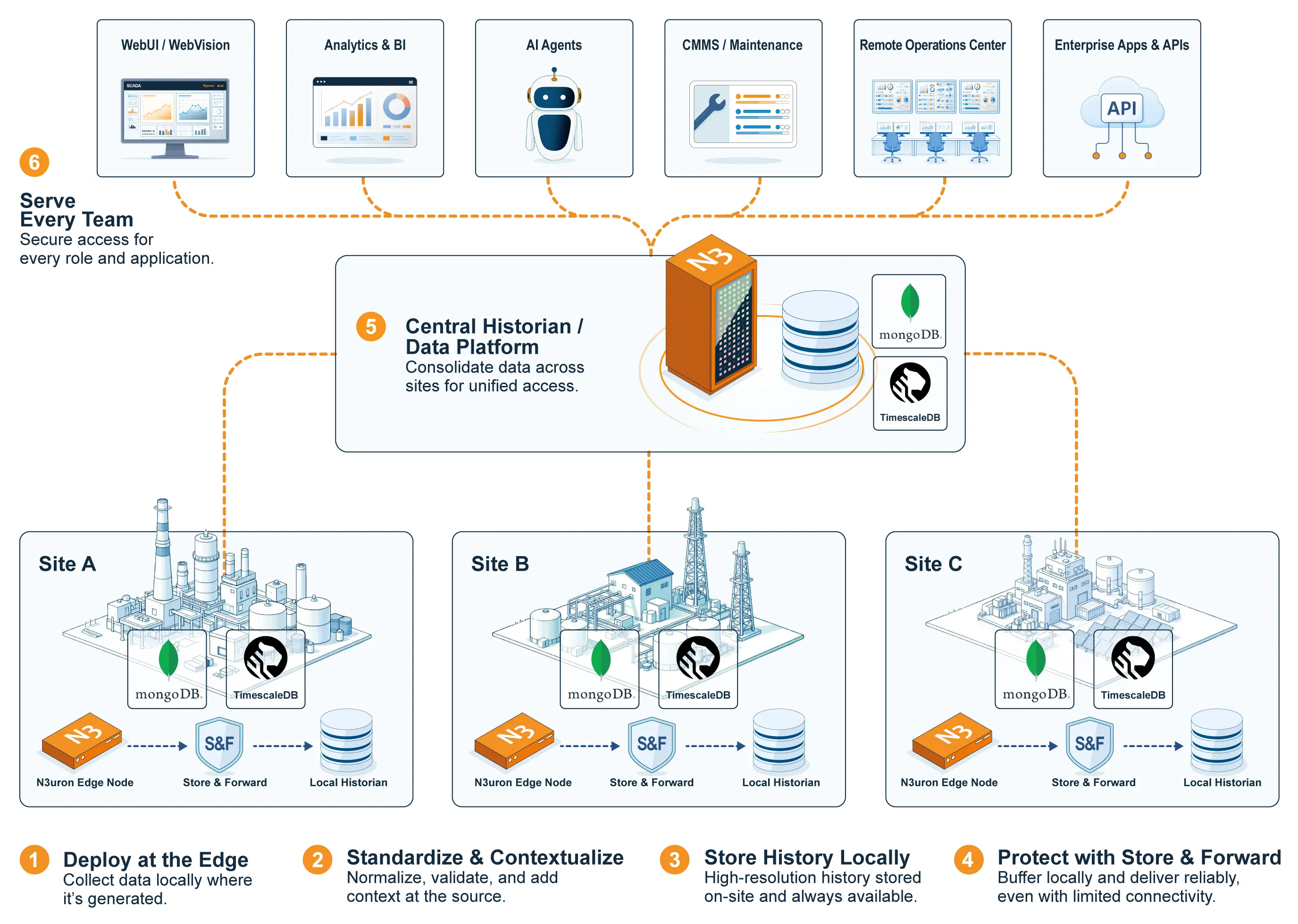
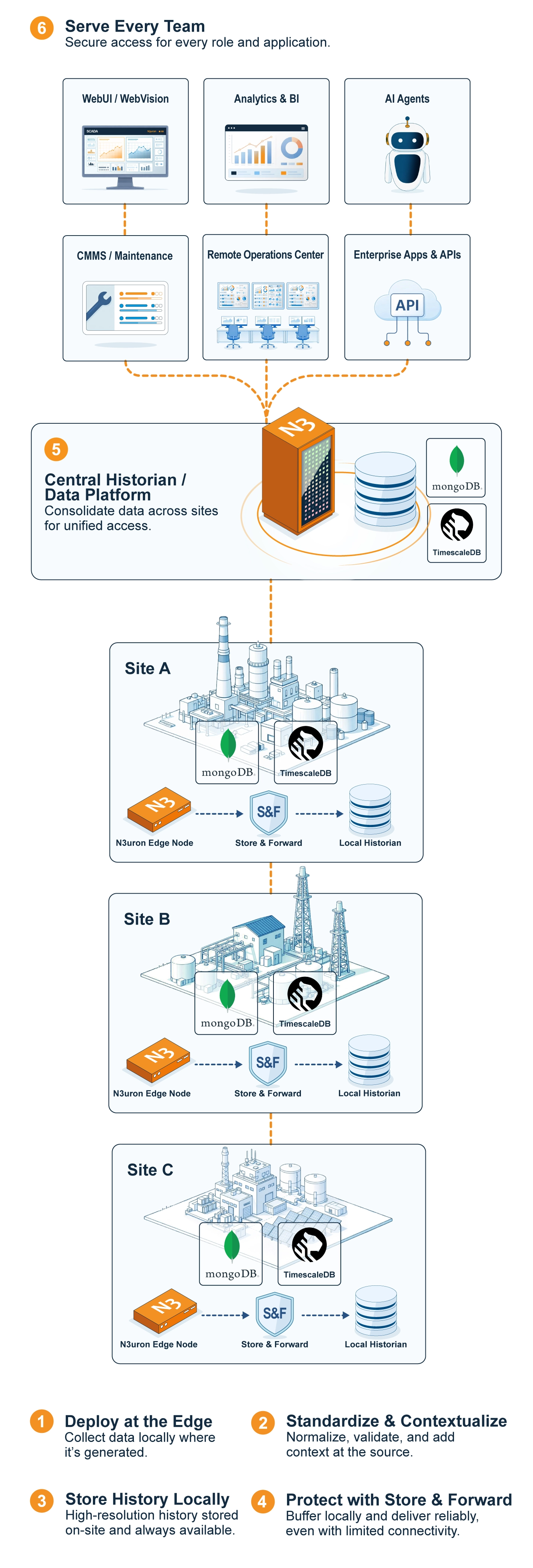
Industrial Historian architecture showing edge deployment, EmbeddedDB, MongoDB, TimescaleDB, centralized historical data storage, and enterprise data access.

Edge to enterprise historian architecture: store data locally, protect it with Store & Forward, and centralize historical data when broader visibility is required.

Deploy N3uron at the Edge

Collect industrial data close to operations.

Standardize & Contextualize

Normalize tags, model assets, and create consistent data context.

Store History Locally

Start historizing data at the site with embedded or external storage.

Protect History with Store & Forward

Buffer data locally and forward it automatically when service is restored.

Centralize When Needed

Consolidate historical data for enterprise visibility, analytics, and reporting.

Visualize, Analyze & Serve

Make historical data available to the applications, services, and teams that need it across the organization.

When Historical Data Doesn’t Scale, Operations Start to Break

In distributed environments, storing data is not the problem. Keeping it consistent, reliable, contextualized, and usable across sites is.

Every site evolves differently
Silos, custom configurations, and local fixes make standardization nearly impossible.

Data gaps appear when connectivity fails
Outages and unstable networks lead to missing data, exactly when continuity matters most.

Scaling becomes expensive fast
More sites, tags, connections, and users mean higher licensing, infrastructure, and operational costs.

Data is stored, but not ready to use
Siloed data, inconsistent context and difficult access slow down analytics, AI and decision-making.

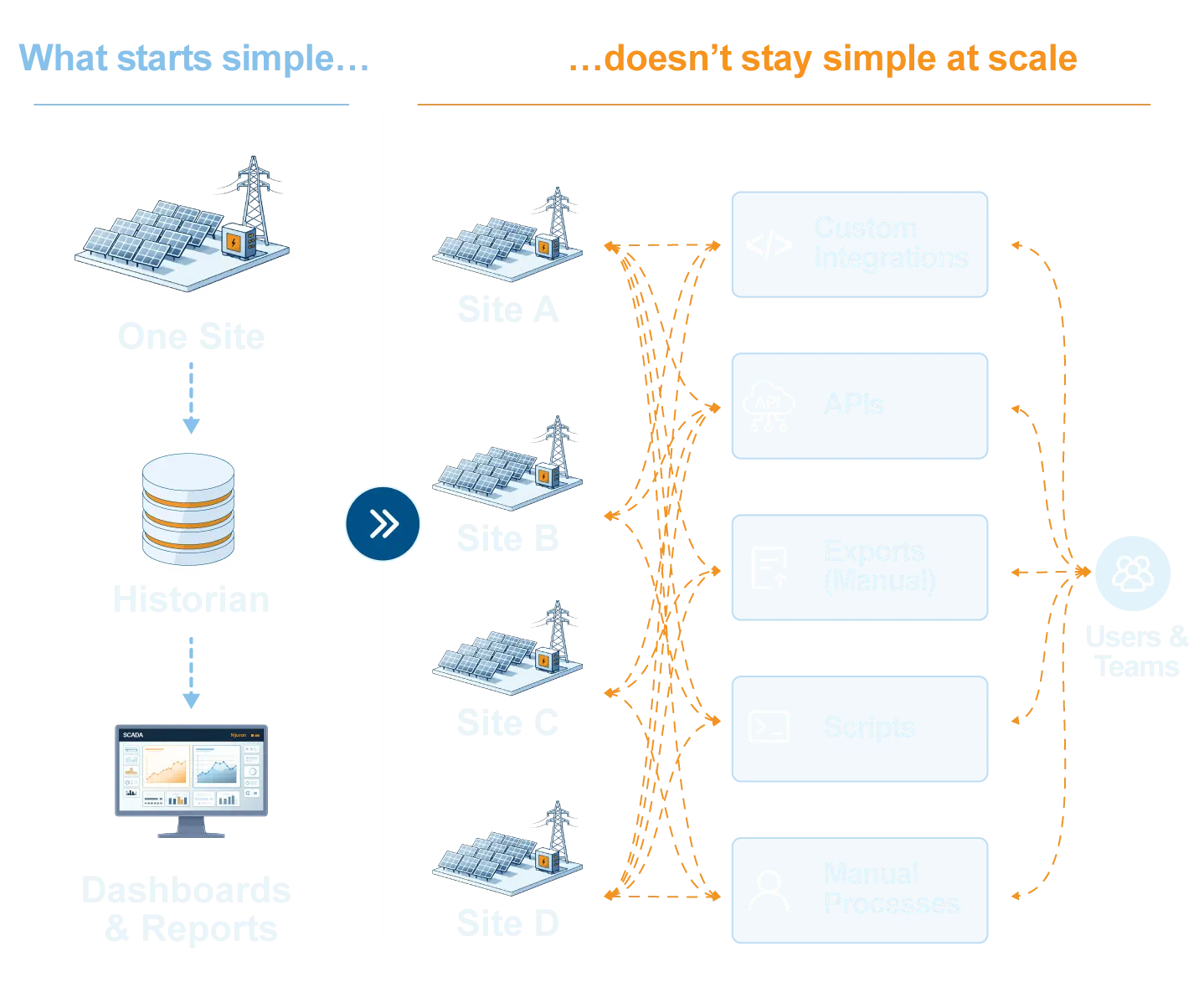
Diagram showing how a single-site historian setup becomes complex at scale, requiring custom integrations, APIs, manual exports, scripts, and manual processes across multiple sites

Every site evolves
differently
Silos, custom configurations, and local fixes make standardization nearly impossible.

Scaling becomes
expensive fast

More sites, tags, connections, and users mean higher licensing, infrastructure, and operational costs.

Data gaps appear when connectivity fails
Outages and unstable networks lead to missing data—exactly when continuity matters most.

Data is stored, but not
ready to use

Siloed data, inconsistent context and difficult access slow down analytics, AI and decision-making.

This is where most historian approaches stop scaling.

More systems

More integrations

More cost

More risk

Multi-site historian environments need consistent context, reliable data continuity, and a scalable architecture from the beginning.

Each site becomes a different system

Historization evolves independently at every site, making it difficult to standardize data structures, context, and operating practices across the organization.

Critical history is lost when networks fail

Remote sites often depend on unstable communications. Without reliable local buffering, valuable operational data can be lost when it matters most.

Adding new sites means starting over

Different configurations, tools, and engineering practices make every new deployment slower, harder to maintain, and more expensive to scale.

Historical data rarely becomes operational intelligence

Without consistent asset models and context, every dashboard, report, analytics initiative, and AI project requires additional engineering before the data can deliver value.

This is where most historian approaches stop scaling.


Store Historical Data That’s Ready to Use

N3uron Historian stores data that has already been collected, standardized, normalized, and contextualized by the N3uron platform, so teams can access reliable history without rebuilding context in every application.

Instead of sending raw tags downstream and forcing every team to interpret them again, N3uron preserves the operational context created at the edge. That means analytics, reporting, maintenance, and operations teams can work from the same structured historical data.

Consistency

Standardized before it’s stored

Historical data follows consistent naming, structure, and models across sites, so every plant speaks the same data language.

Context

Context preserved from edge to enterprise

Asset hierarchy, metadata, and operational meaning travel with the history instead of being rebuilt in every downstream tool.

Access

Self-service access for every team

Make history available through WebUI, Web Vision, SQL, REST API, OPC UA, Scripting, and MCP Server.

Speed

Faster analysis and decision-making

Eliminate manual preparation, exports, and rework so teams can move from historical data to insight and action faster.

N3uron turns historical data into a shared operational asset, not another isolated database.

Start Historizing in Seconds. Scale with MongoDB and TimescaleDB.

Start instantly with EmbeddedDB, move to MongoDB when you need your own database infrastructure, or use TimescaleDB for high-volume historian workloads with SQL access.

N3uron Historian does not force every project into the same storage model. Use the storage path that fits your current deployment, then evolve the architecture as data volume, governance, performance, and enterprise access requirements grow.

EmbeddedDB powered by MongoDB

PLUG AND PLAY

Plug-and-play historian storage included with N3uron.

Works out of the box

No database setup required

Small to mid-size sites

Start logging, storing, and querying tag history immediately

MongoDB for Managed Historian Storage

MANAGED GROWTH

Scale from embedded storage to your own MongoDB instances.

Use your own database infrastructure

Manage site-level historian storage

Support site level or central historian architectures

Keep the same N3uron Historian workflow

TimescaleDB for High-Volume Historian Workloads

HIGH VOLUME

Built for large-scale time-series storage and SQL access.

Built for demanding historian deployments

Efficient long term history at scale

Direct SQL access for analytics, BI, and reporting

Cost efficient path for large data volumes

One Historian. Multiple storage paths. No architecture rebuild.

Keep Historical Data Reliable When Connectivity Fails

Industrial networks are not perfect. Sites can go offline, databases can become temporarily unavailable, and connections can drop. N3uron Historian is designed to protect historical data in those conditions.

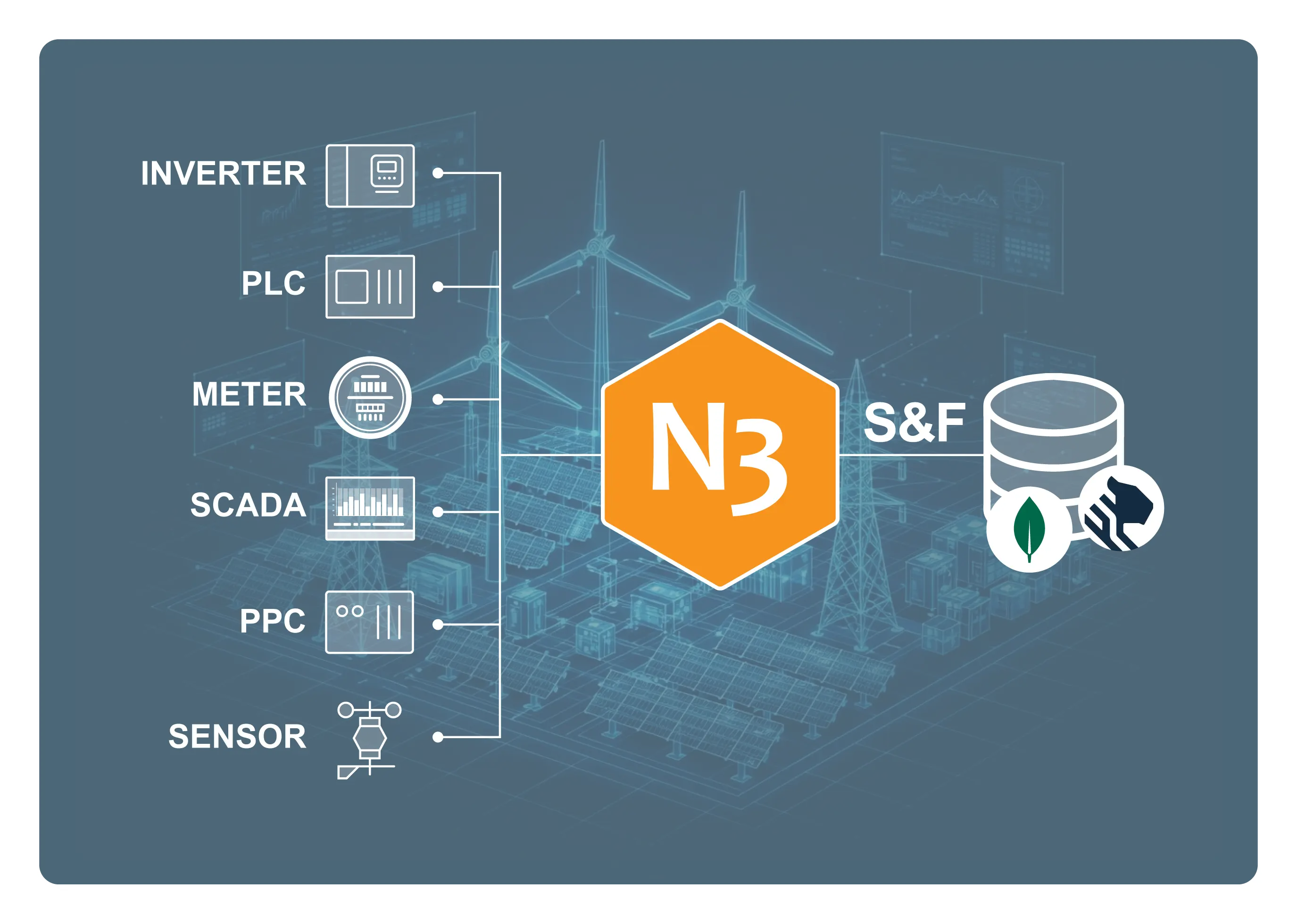
With Store & Forward, historical data is buffered locally when it cannot be delivered and automatically forwarded once service is restored, helping maintain reliable history across local, distributed, and centralized historian architectures.

N3uron Historian data continuity architecture showing field devices (inverter, PLC, meter, SCADA, PPC, sensor) connected through Store & Forward to MongoDB and TimescaleDB storage

Store & Forward buffers historical data locally during interruptions and forwards it automatically once service is restored.

Buffer data during interruptions

Keep historical data locally when connectivity or database availability is interrupted.

Recover automatically

Forward buffered data once service is restored.

Protect site-to-central flows

Support resilient historical data movement across distributed operations.

Reduce gaps in historical records

Maintain more complete history for analysis, reporting, troubleshooting, and compliance.

Store locally. Forward automatically. Keep history reliable across every site.

Break the Scaling Curve

Scaling sites shouldn’t mean scaling cost and complexity

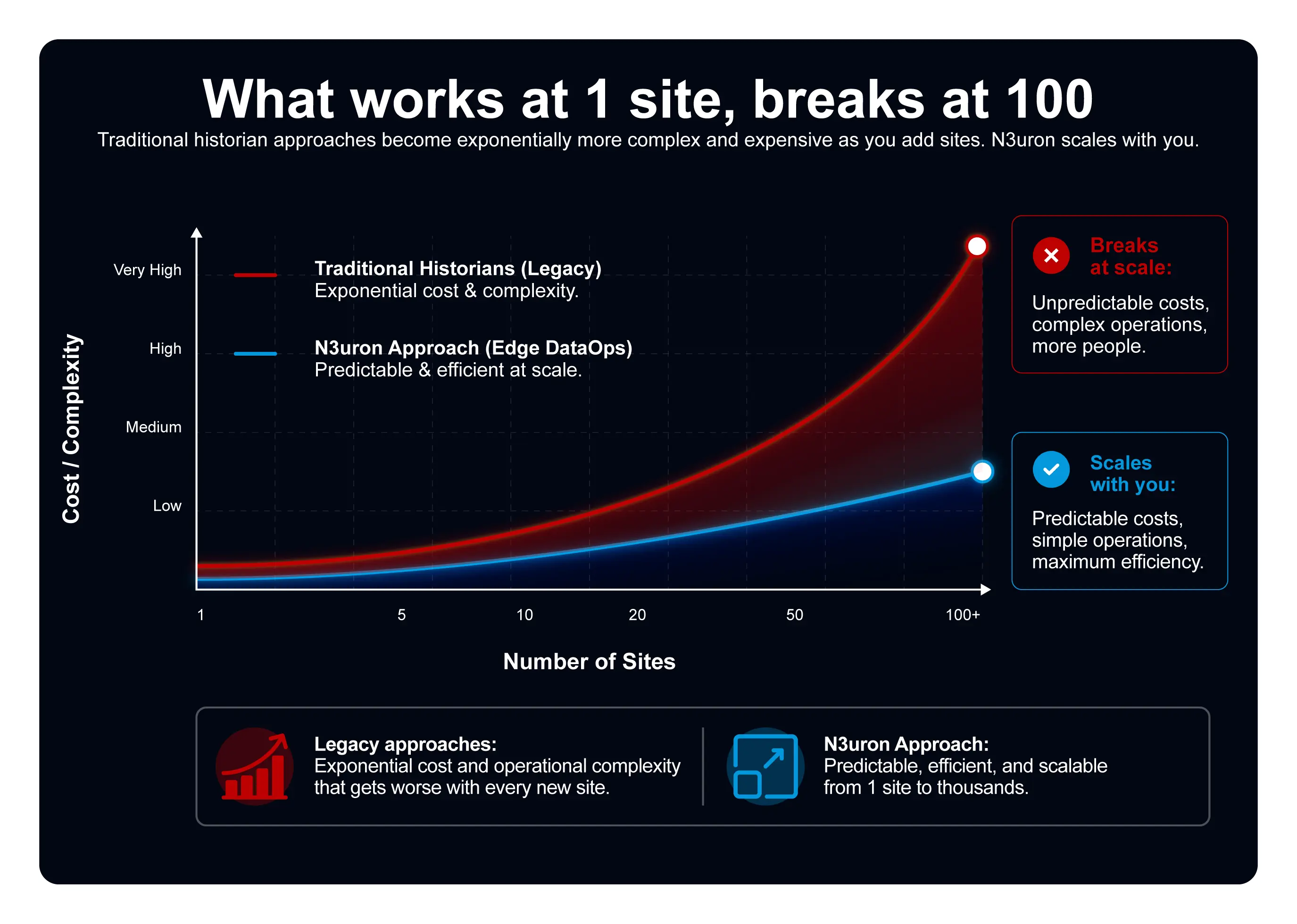
Traditional historian architectures struggle when every new site adds more licenses, more infrastructure, more engineering work, and more maintenance.

Chart comparing cost and complexity of traditional historians versus N3uron as sites scale from 1 to 100+

Traditional approach

Each new site adds cost, effort, and overhead.


More licenses

More infrastructure

More engineering work

More operational overhead

N3uron approach

Standardize once, replicate across sites, and scale without penalties.


Unlimited tags

Unlimited users

Unlimited devices

Unlimited connections

Standardized deployments across sites

Reusable data models and configurations

Scaling your operations shouldn’t mean multiplying cost, effort, and complexity.


High-Performance Historization at Real Industrial Scale

N3uron Historian is built for high-frequency industrial data, large deployments, and demanding operational environments where storage efficiency, ingestion speed, retrieval performance, and data continuity matter.

Extreme storage efficiency

Store up to 150 million events in 1 GB, reducing infrastructure footprint while preserving high-resolution history.

Millions of events per second

Handle massive ingestion workloads from distributed industrial systems.

Retrieve a full year of data in seconds

Access long periods of historical data quickly for troubleshooting, analytics, and reporting.

Millions of tags in a single instance

Scale historian deployments without turning tag growth into an operational bottleneck.

Store & Forward for resilient history

Buffer historical data during connectivity or database interruptions and automatically forward it once service is restored.

Unlimited licensing

Scale tags, users, devices, and connections without licensing constraints slowing down your rollout.

Retrieve, Visualize, and Analyze Historical Data with WebUI and Web Vision

N3uron Historian makes historical data easy to access and explore directly from N3uron’s WebUI and Web Vision.

Users can retrieve historical values, review trends, analyze alarms, and visualize operational data without leaving the platform, helping teams identify patterns, troubleshoot issues, and make better decisions faster.

Because the data has already been standardized, normalized, and contextualized, teams can work with meaningful historical information instead of isolated raw values.

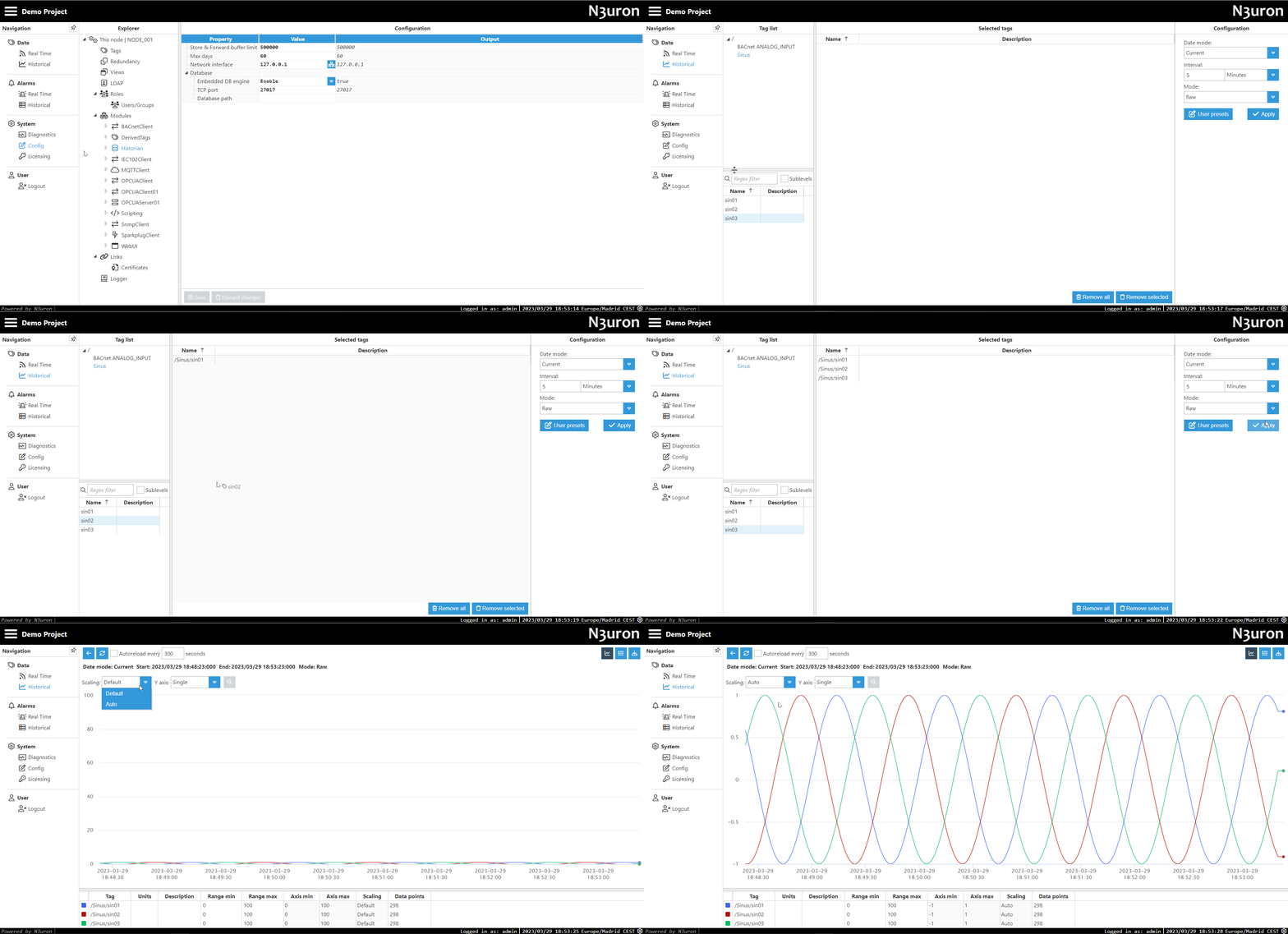
Animated demonstration of N3uron Historian module configuration settings, including Store & Forward buffer limit, database engine, and network settings

Configure, retrieve, visualize, and analyze historical data directly from N3uron WebUI and Web Vision.

Retrieve historical data directly from WebUI

Visualize trends and alarms in Web Vision

Compare historical behavior across assets and sites

Identify anomalies, patterns, and recurring issues

Support faster troubleshooting and operational analysis

Historical data becomes easier to understand, easier to share, and easier to act on.

From Any Industrial Source to Usable Historical Data

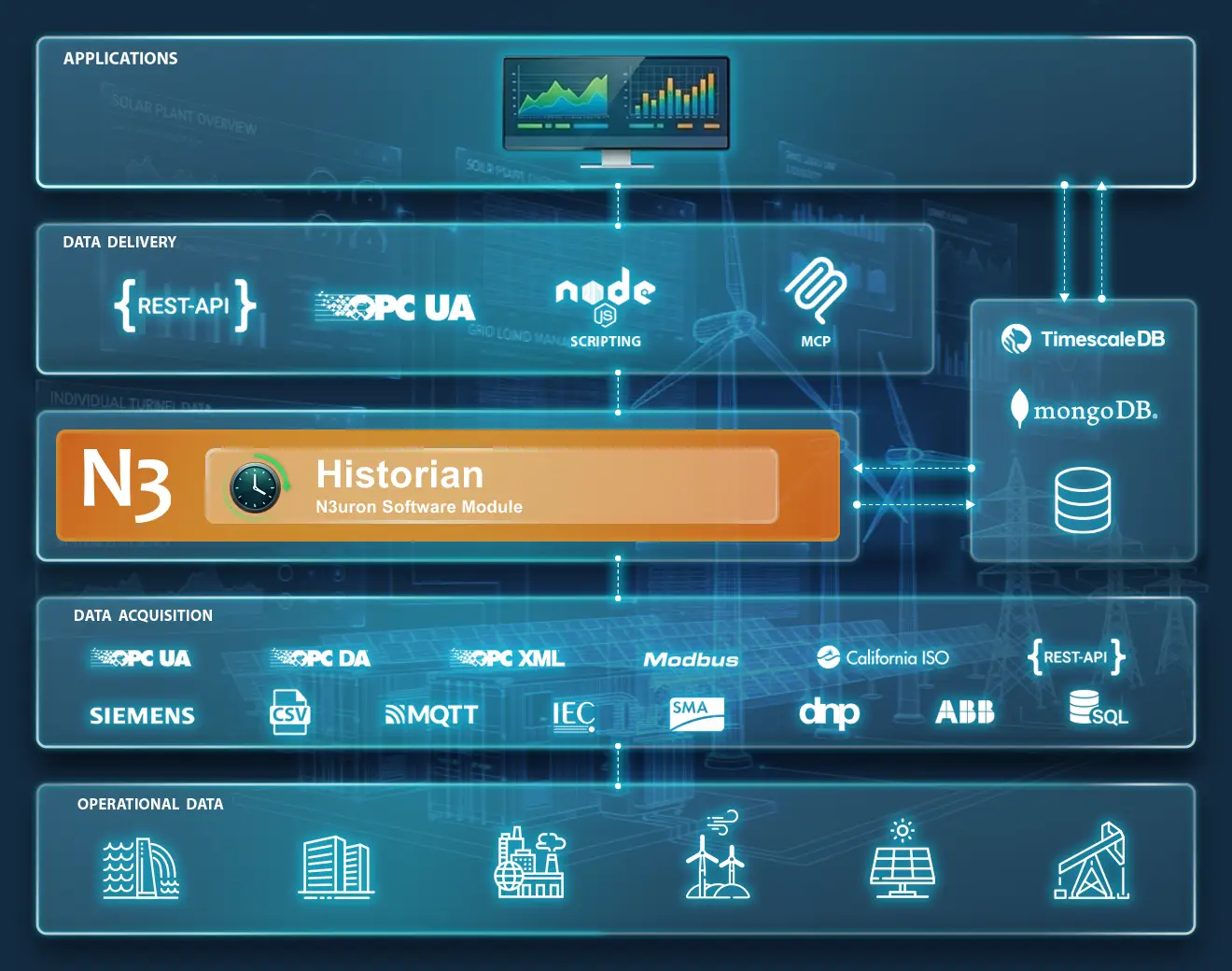
N3uron Historian captures and preserves operational data at the edge, making reliable historical data available to the teams, applications, and services that depend on it.

Data can be collected from PLCs, SCADA systems, meters, sensors, databases, and industrial equipment, then standardized, normalized, contextualized, and stored by N3uron Historian. Once stored, it can be accessed through WebUI, Web Vision, SQL, REST API, OPC UA, Scripting, and MCP Server.

N3uron Historian architecture showing data flow from operational sources (industrial equipment, sensors, SCADA) through data acquisition protocols, the Historian module, MongoDB/TimescaleDB storage, and delivery via REST API, OPC UA, Scripting, and MCP Server to applications

Open historical data access across visualization, analytics, reporting, enterprise applications, and operational services.

WebUI and Web Vision

Retrieve, visualize, and analyze historical data directly inside N3uron.

SQL access with TimescaleDB

Query and integrate historical data when enterprise analytics, reporting, BI, or data platform access is required.

REST API Server

Serve historical data securely to applications, services, and web systems.

OPC UA

Expose historical data through standard OPC UA access.

Scripting

Automate retrieval, transformation, and operational workflows.

MCP Server

Expose contextualized operational and historical data to AI agents through governed access.


Make your historian AI-ready with MCP Server.

N3uron MCP Server allows AI agents to securely query contextualized real-time and historical data, helping teams accelerate diagnostics, reporting, and AI-assisted operational decision-making.

Explore MCP Server

Collect from anywhere. Store with context. Serve history everywhere.

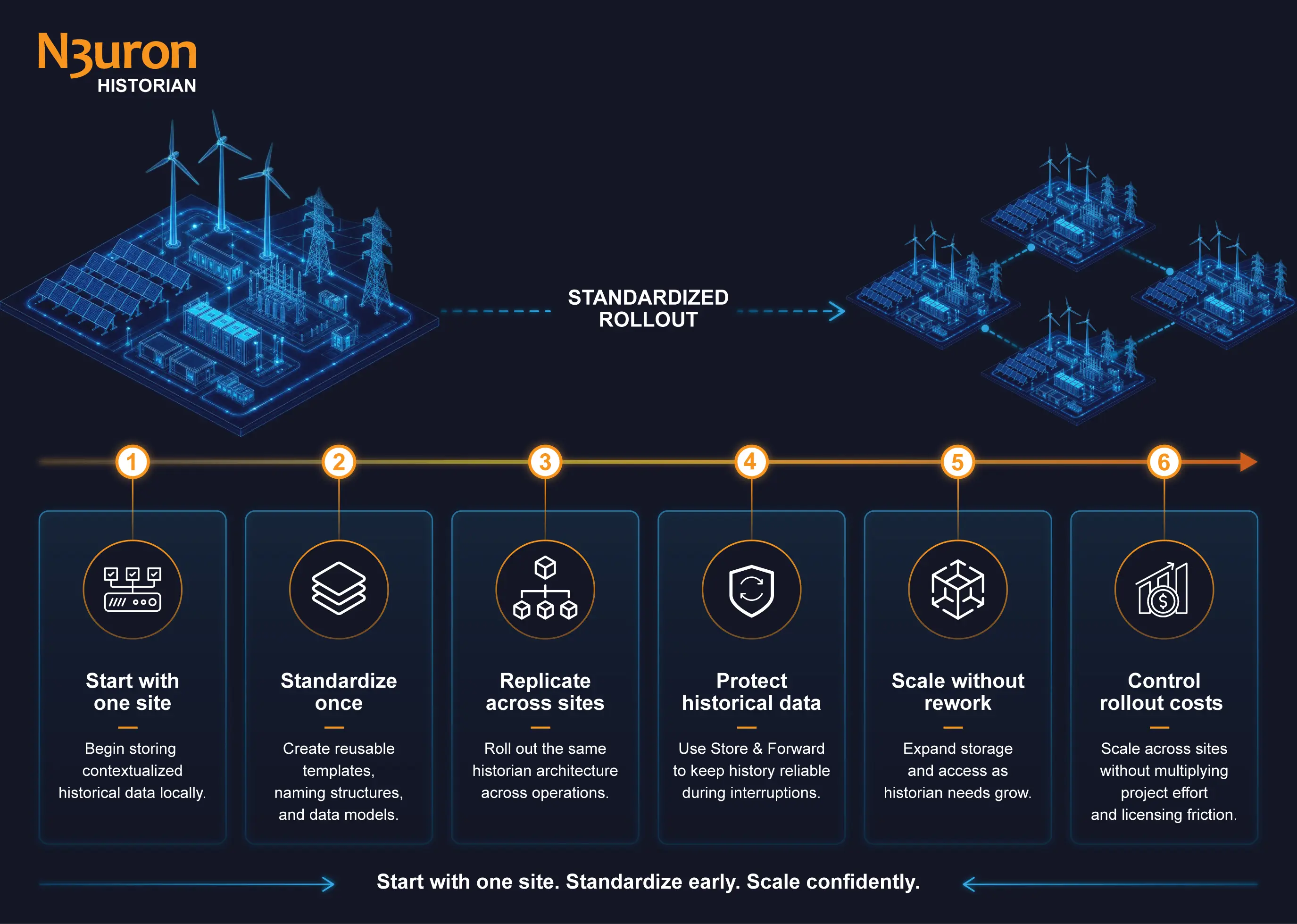
From First Site to Fleet Rollout

Deploy N3uron Historian once, standardize your model, and replicate the same architecture across sites without rebuilding each project from scratch.

N3uron Historian fleet rollout roadmap showing six steps: start with one site, standardize once, replicate across sites, protect historical data, scale without rework, and control rollout costs

Start with one site, standardize once, and replicate the same historian architecture across distributed operations.

Start with one site

Begin storing contextualized historical data locally with EmbeddedDB, without deploying external database infrastructure from day one.

Standardize once

Create reusable templates, naming structures, and data models so historian records stay consistent across sites.

Replicate across sites

Use the same configuration patterns to accelerate rollout across plants, remote assets, and distributed operations.

Protect historical data

Use Store & Forward to keep historical data reliable when connectivity fails or remote sites operate with unstable networks.

Scale without rework

Move to MongoDB or TimescaleDB instances as data volume, retention, SQL access, or enterprise reporting needs grow.

Control rollout costs

Scale across sites with unlimited tags, users, devices, and connections, without turning every new site into a new licensing problem.

Start with one site. Standardize once. Replicate across operations. Protect historical data. Scale without rework.

Not Just a Historian. A Distributed DataOps Layer for Historical Industrial Data

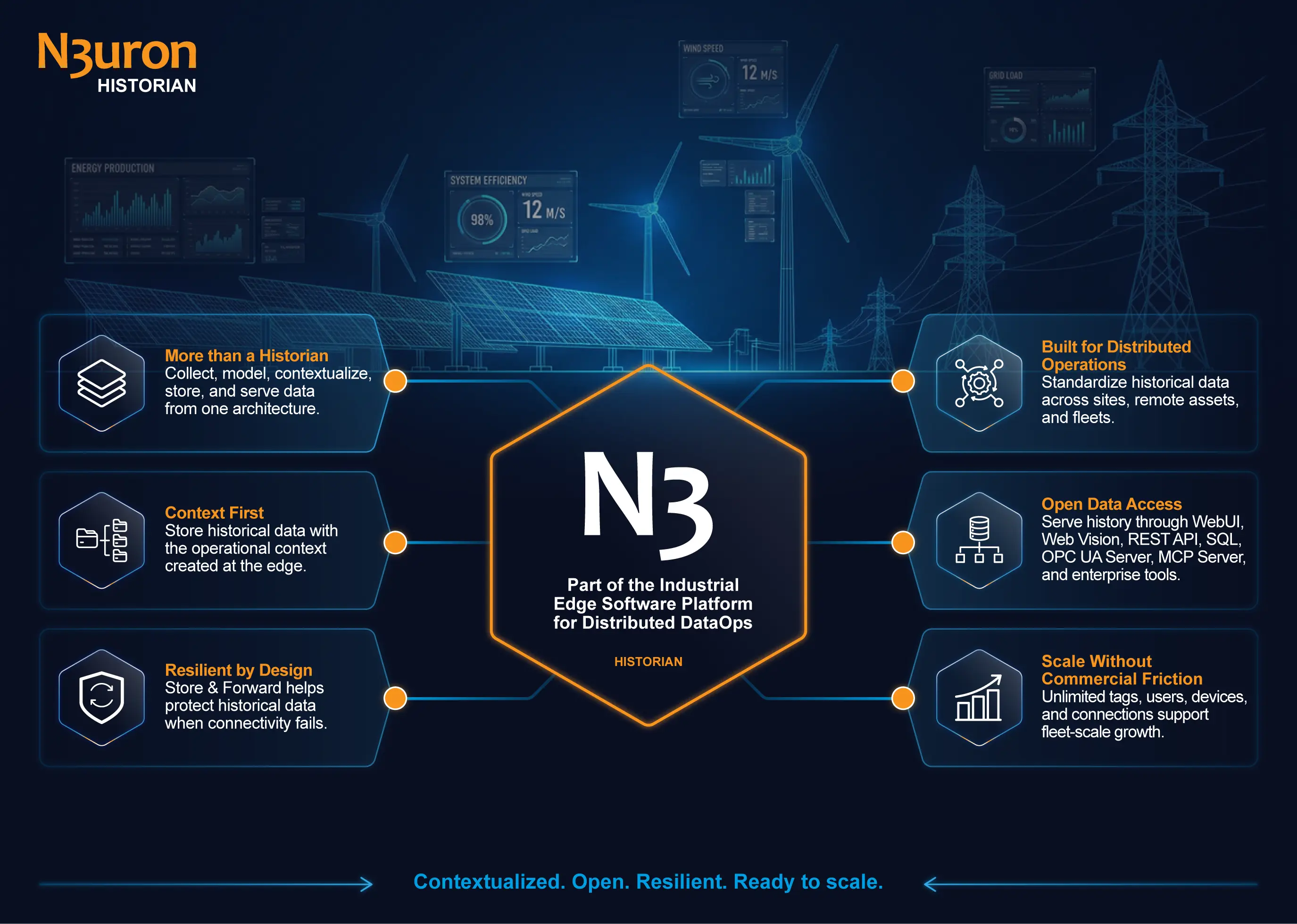
N3uron Historian is part of N3uron, the Industrial Edge Software Platform for Distributed DataOps. Historical data is collected, modeled, contextualized, protected, and served from the same edge architecture that connects your operations.

N3uron Historian positioned within the Industrial Edge Software Platform for Distributed DataOps, showing six pillars: more than a historian, built for distributed operations, context first, open data access, resilient by design, and scale without commercial friction

Six reasons N3uron Historian is built for distributed industrial DataOps, not isolated historian projects.

More than a Historian

Historical data is not stored as an isolated database. It is part of a broader industrial edge platform for connectivity, modeling, contextualization, storage, and data access.

Built for distributed operations

Designed for multi-site environments, remote assets, and fleets, N3uron helps teams standardize historical data across operations instead of managing isolated historian projects site by site.

Context first, not raw tags

N3uron stores history with the operational context created at the edge, making historical data easier to understand, compare, analyze, and reuse across teams.

Open data access

Serve historical data through WebUI, Web Vision, REST API, SQL, OPC UA, MCP Server, BI tools, analytics platforms, and enterprise systems.

Resilient by design

Store & Forward protects historical data when connectivity fails, helping remote and distributed operations maintain reliable records even with unstable networks.

Scale without commercial friction

Unlimited tags, users, devices, and connections help prevent licensing complexity and cost from growing every time you add more sites, assets, or data consumers.

FAQs

What is an industrial historian?

An industrial historian captures, stores, and retrieves time-series data from industrial systems, making process history available for visualization, reporting, troubleshooting, analytics, and operational decision-making.

What makes N3uron Historian different?

N3uron Historian is part of N3uron, the Industrial Edge Software Platform for Distributed DataOps. It stores historical data that has already been standardized, normalized, and contextualized at the edge, then makes it available across the organization through open standards such as SQL queries, REST API Server, OPC UA, MCP Server, and other integration paths.

Can N3uron Historian be used for a single site?

Yes. N3uron Historian can be deployed locally at a single site using EmbeddedDB powered by MongoDB, allowing users to start storing historical data quickly without external database infrastructure.

Can N3uron Historian scale to multi-site or enterprise deployments?

Yes. N3uron Historian is designed to scale from local site storage to distributed and centralized architectures using the same platform approach.

What storage options does N3uron Historian support?

N3uron Historian supports EmbeddedDB powered by MongoDB, external MongoDB, and TimescaleDB, allowing organizations to start quickly, use their own database infrastructure, or scale to high-volume enterprise historian architectures.

Why use TimescaleDB with N3uron Historian?

TimescaleDB is well suited for high-volume historian deployments, centralized historical data architectures, and enterprise use cases where historical data needs to be queried, analyzed, and integrated with analytics, BI, reporting, and data platforms.

How does N3uron help prevent historical data loss?

N3uron uses Store & Forward to buffer historical data locally when connectivity or database availability is interrupted, then automatically forwards it once service is restored.

Can users visualize historical data inside N3uron?

Yes. Users can retrieve, visualize, and analyze historical data and alarms through N3uron WebUI and Web Vision.

How can teams and applications access historical data?

Historical data can be accessed through WebUI, Web Vision, SQL, REST API, OPC UA, Scripting, and MCP Server.
Is N3uron Historian AI-ready?

Yes. Through MCP Server, N3uron can expose contextualized operational and historical data to AI agents through governed access.
Why does context matter in an industrial historian?

Context makes historical data easier to understand and use. Instead of storing raw tags in isolation, N3uron stores data that has already been standardized, normalized, and contextualized.

Is N3uron suitable for enterprise historian architectures?

Yes. N3uron supports local and centralized historian patterns, making it suitable for edge, site, and enterprise-scale operations.

Contact Us
Download N3uron